
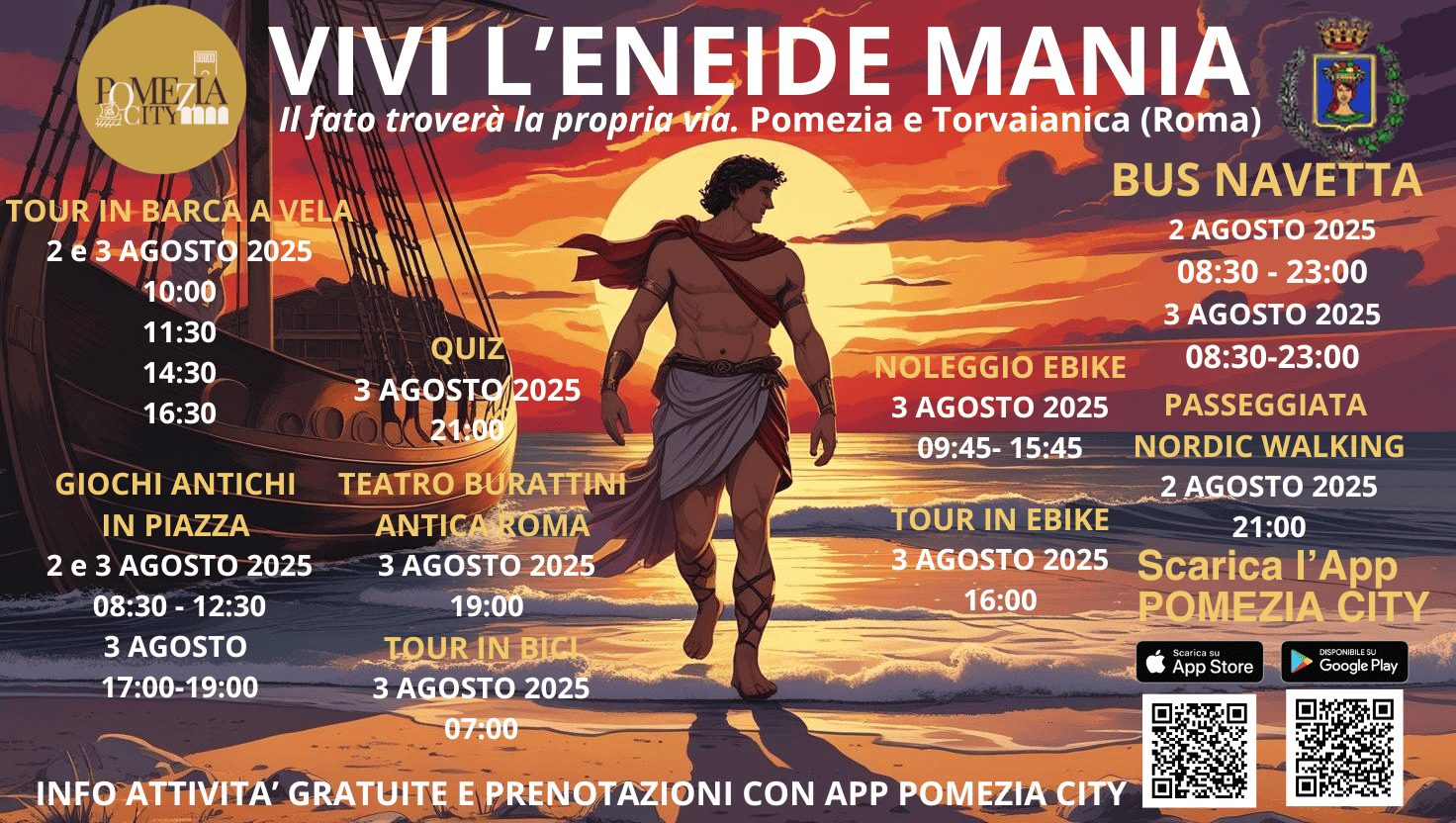
A Journey Between Myth and Reality
“The Landing of Aeneas” is much more than just an event: it is a unique opportunity to immerse yourself in the historical and mythological roots of Pomezia. We celebrate the landing of the Trojan hero Aeneas on our shores, a fundamental moment that gave rise to one of the most fascinating stories in Roman mythology.
After a long journey fleeing the destruction of Troy, Aeneas and his companions arrive on the coast of Lazio. As the sun rises, the sea calms down. A river and a forest attract Aeneas’ attention. With determination, the Trojan hero makes his way and reaches the banks of the river, where he decides to stop. His mission seems to have finally come to fruition.
Meanwhile, Latino, king of Laurentum and ruler of the inhabitants of those lands, is worried about the fate of his kingdom and his only daughter, Lavinia. An oracle predicts that a foreign man will lead the Latins and bring glory and imperishable memory, and that Lavinia will marry him. Despite the marriage proposal of Turnus, leader of the Rutuli, Lavinia’s fate seems already sealed.
Aeneas celebrates his arrival with sacrifices to the gods and during a banquet three flashes of lightning from Jupiter confirm that this is the place chosen by Fate to found a new homeland. Aeneas sends messengers to King Latinus, who welcomes him benevolently, but is torn between respect for divine auspices and his alliance with Turnus.
The peace between the Trojans and the Latins is short. Juno unleashes the fury of Aletto, who sows discord. Aletto bribes Queen Amata, who opposes Lavinia’s marriage to Aeneas, preferring Turnus. Conflict between peoples is inevitable.
The war escalates and culminates in a duel between Aeneas and Turnus. When Aeneas kills Turnus, destiny is fulfilled. Aeneas’ forces prevail and the prophecy comes true: Aeneas’ descendants will give life to Rome, marking the beginning of the city’s greatness.
The Sanctuary of Sol Indiges is located in an area rich in history, mythology and culture, inextricably linked to the Trojan hero Aeneas. Legend has it that, after the fall of Troy, Aeneas landed on the Lazio coast, near the mouth of the Numicus river, where he founded a sacred area dedicated to the “Sun Progenitor of all things” (Sol Indiges).
The site, located between the military airport of Pratica di Mare and the coast of Torvaianica, has undergone significant transformations over the centuries. Originally part of a vast lagoon, the area was reclaimed in the sixteenth century, but only through archaeological excavations conducted by the University of Rome “La Sapienza” did the true historical significance of the place emerge. The sanctuary, dating back to at least 520 BC, consisted of a rectangular temple adorned with terracotta statues, which decorated its top.
In the third century BC, the sanctuary was enlarged and rebuilt, with the addition of a temple. Its size and importance are demonstrated by the imposing perimeter walls that measured 120 meters on one side and 110 on the other. This sacred place continued to be a religious and cultural landmark until the imperial era, when its religious function ceased and the site was progressively transformed for practical purposes.
The most recent archaeological finds, carried out between 2009 and 2010, have revealed coins and artifacts that date back to the fourth century AD, during the reigns of Constantine and Constantius II. Although the sanctuary had lost its religious role, the area continued to be used until more recent times.
Today the archaeological site of the Sanctuary of Sol Indiges cannot be visited, but the legendary area of Aeneas’ landing, located in the ditch of Pratica di Mare, remains a place of great charm. Here, where the Numicus river once flowed, the visitor can perceive ancient history, immersing himself in the era in which myth and reality were deeply intertwined.
The history of Lavinium blends between myth and historical reality. According to legend, it was founded by Aeneas and was named after Lavinia, his wife and daughter of King Latinus. Archaeological excavations confirm that Lavinium stood in the current hamlet of Pratica di Mare, near Pomezia. Located in the Latium Vetus, the city prospered over the centuries due to its strategic location and religious role. The ancient Romans considered it a sacred place, so much so that the consuls went there every year to perform ritual sacrifices. According to historians such as Dionysius of Halicarnassus, Aeneas would have kept here the Penates, the gods brought from Troy, symbols of divine protection over Rome.
The archaeological excavations, started in 1957 by the University of Rome, brought to light a burial mound of 18 meters in diameter, dating back to the seventh century BC, containing dozens of precious objects including vases, weapons and silverware. This discovery, one of the most important of the twentieth century, strengthened the link between Lavinium and the mythical origins of Rome. Some scholars speculate that the mound corresponds to the Heroon of Aeneas, the funeral monument dedicated to the legendary founder of Lavinium and progenitor of the Romans. Dionysius of Halicarnassus, in his writings, places the mound of Aeneas in this area, fueling a fascination that continues to capture the attention of tourists and scholars.
Investigations have revealed numerous structures, such as the city walls and baths, that have witnessed the prosperity of Lavinium. Also of great importance is the Sanctuary of the XIII Are, a place of sacrificial rites in honor of the deities. A votive deposit dedicated to Minerva, containing numerous terracotta statues, has made it possible to better understand the cults and rites practiced in the city. In the following years, the site continued to unveil treasures, such as the discovery of the XIV Altar, confirming the importance of Lavinium in the religious and cultural context of ancient Lazio, with direct connections between Greece and Rome, without the filter of the Etruscans.
Considered a point of reference for the cults and traditions of the Latins, Lavinium today preserves its memory in the “Lavinium” Archaeological Museum. The archaeological heritage of the site offers a valuable key to understanding the religious, social and political life of this ancient settlement. Every find, every fragment, tells the story of a city that not only welcomed Aeneas, but became a crossroads of culture and spirituality, contributing decisively to the formation of Roman civilization.
Imagine a sunset at the mouth of the Numico river, the current Fosso di Pratica di Mare, where for thirty years one of the most evocative celebrations of the mythical roots of the Lazio region has come to life: the re-enactment of the Landing of Aeneas. Organized by the Tyrrhenum Cultural Association and inspired by episodes from Virgil’s Aeneid, this event combined myth, history and community, leaving an indelible mark on the collective memory.
Every year, on June 21st, the day of the summer solstice, re-enactors, actors and volunteers brought back to the stage the arrival of the Trojan hero and his entourage on the Lazio coasts, in the places that legend tells as the cradle of the future Rome. The mouth of the Numico was transformed into an open-air theater, where myth and ancient rites came to life.
Highlights include:
and his companions, accompanied by the Penates, sacred symbols of their lost homeland, and by the distribution of the “mense” (spelt scones) by the handmaidens.
between Trojans and Latins, sanctioned with dances, libations to the goddess Vesta and the god Janus, and a symbolic exchange of gifts, including the Trojan land mixed with the local sand, to symbolize the integration of the two peoples.
exciting, with the blessings of the god Faun and the embrace between Aeneas and King Latinus, to seal peace and the beginning of a common future.
An event that for years has united communities and generations, leaving behind a trail of culture, passion and identity that still resonates in the hearts of those who lived it.
Discover the profiles of the participants, their challenges and follow your favorites!
Every “Like” can make the difference in the final ranking.
A great recreational and sporting event open to all:
Do you want to become the protagonist of “The Landing of Aeneas”? Follow a few simple steps and join us on this unique adventure! Sign up, tell your story, and start gathering support from friends and family to climb the leaderboard. Every “Like” is a step towards victory!
Come and discover for yourself the places of the myth of the “Landing of Aeneas” in the territory where the history of Rome began.
It will be an opportunity to learn, have fun, socialize and discover the rich cultural and historical heritage of Pomezia.
Become part of history! Join us.

